

Blog&News
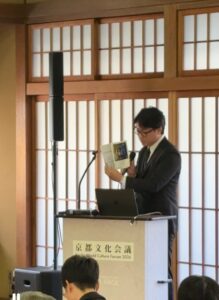
The Kyoto Cultural Conference was held over two days, October 22 and 23, at Ninna-ji Temple in Kyoto.
On the first day in the “Ōuchi-no-ma” room: Speakers gave presentations on the themes of evolving AI and culture, and the changing natural environment and culture.
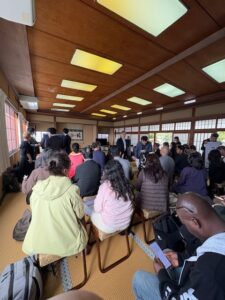
Under the theme “Culture x AI,” culture was broken down into the five senses, and representatives from various AI fields delivered a series of presentations on the relevance of AI to culture, exploring just how closely AI can approximate the human senses.
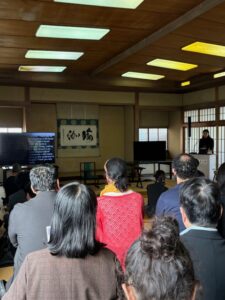
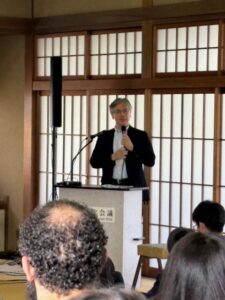
Regarding research on “olfaction”—which uses sensors and AI to record and reproduce scents—it was noted that while scents can be reproduced numerically, the culture of kodo (the Way of Incense) is only truly realized when combined with the spatial context and the passage of time of a given place; therefore, reproducing it at the level of culture is difficult. Additionally, while “tactile sensation” is being studied using robotics, it was pointed out that who touches whom and the nature of that relationship vary from person to person, and that technology alone cannot bridge that gap.
Under the theme “Culture x Environment,” young people of the next generation took the lead in presenting initiatives aimed at taking action to shape the future they envision by treating global environmental issues as matters of personal concern.
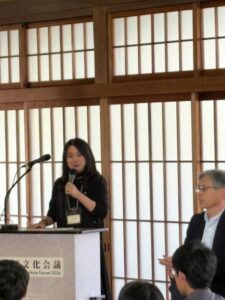
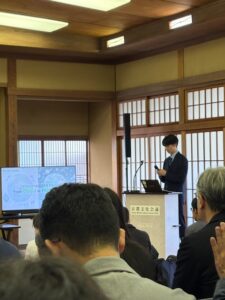
Four students
* presented a forecast for the future as part of a campaign to reduce waste in Kyoto City
* shared their love for adzuki beans and the culture surrounding them
* emphasized the importance of global dialogue on environmental protection, using traditional slash-and-burn agriculture as an example
* advocated for the importance of taking a “one-day cultural leave,” among other topics, each delivering a wonderful five-minute presentation.
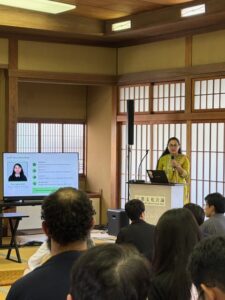
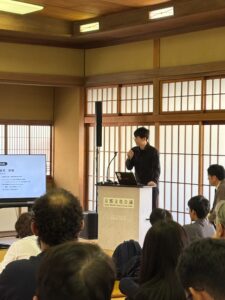
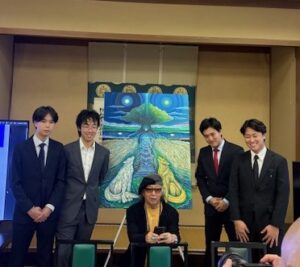
Ren Otani, a Columbia University graduate, took the stage as part of the AI expert team led by Takumi Sato, who is currently a student at Columbia University. Otani is also an entrepreneur who has developed an AI system for educational guidance at international schools, drawing inspiration from Japan’s traditional “terakoya” schools. Their proposals stood out from those of the other presenters.
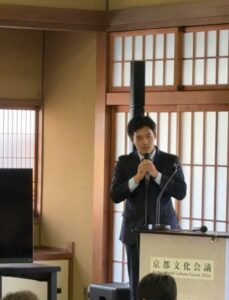
Shiozawa created a work titled “Ask the Earth” to support them.
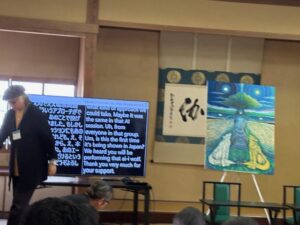
They introduced two AI wolves to reexamine human society and future decision-making from the perspective of animals—suggesting that humans are not the only ones shaping the environment. The Divine Wolf reexamines values from the perspectives of culture, ideology, and philosophy, offering humans a warning and a wake-up call. The AI Wolf answers human questions based on scientific facts, research, and data.
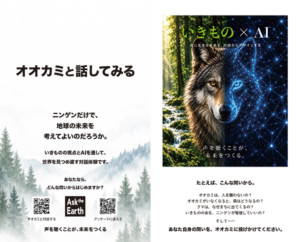
About 30 years ago, the Kyoto Conference was held to discuss the environment, but wasn’t that an anthropocentric approach?
The uniquely human idea of “Let’s ask the animals!” used AI to bring the animals’ voices to this conference. These next-generation initiatives are wonderful.
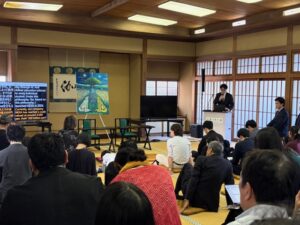
On the following day, the 23rd, a meeting was held in the “Shinden Room,” where visitors are normally not permitted beyond the hallway.
Rev. Daishu Segawa, the 51st head priest of Ninnaji Temple, delivered a greeting.
He stated that the 20th century was a turbulent period of transition, and that in such uncertain times, what matters most is the “power of prayer” and the “power of culture” that connects people. He expressed his hope that the Kyoto Cultural Conference would serve as an opportunity for a diverse group of people to come together and reflect.
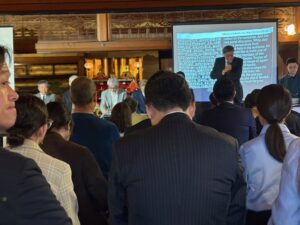
Rather than simply viewing AI in a negative light, today’s meeting explored the question of whether AI can foster the creation of diverse cultures as it advances and matures. The discussion on the theme of AI and culture continued for an extended period, with three panelists sharing their perspectives.
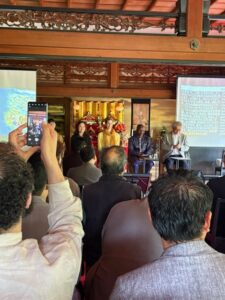
A panel discussion was then held, coordinated by Juichi Yamagiwa, known as “Dr. Gorilla.”
Panelists included a university professor from Ghana, an American research economist, a Vietnamese genetic researcher, and the director of a Japanese kindergarten, among others, who each spoke about what culture means from the perspective of their respective countries and fields of expertise.
What does culture mean in the United States, a nation of immigrants where diverse national cultures intermingle?
What does culture mean in Ghana, a country in Africa with a history of colonization?
These are complex questions that are not easily summarized.
Mr. Yamagiwa’s original comments, which build on their remarks, are truly memorable.
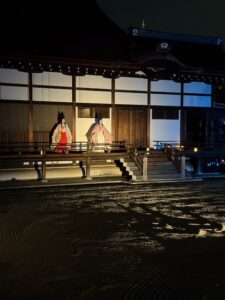
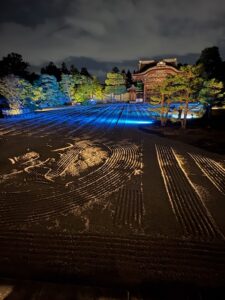
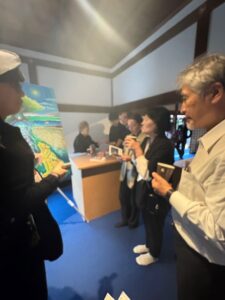
At the reception party, dances performed by maiko and shirabyoshi took place in the spacious garden. The illuminated garden at Ninnaji Temple was breathtakingly beautiful. It was a moment that made me appreciate the beauty of Japanese culture all over again.


We were fortunate enough to have the opportunity to speak with Professor Yamagiwa, and although the conversation centered on animals, we heard many fascinating stories—including differences between wolves in various countries and their sizes.

He has an endless well of knowledge associated with every single word, and he keeps pulling out facts that leave us exclaiming, “Wow!” He is a truly captivating person.
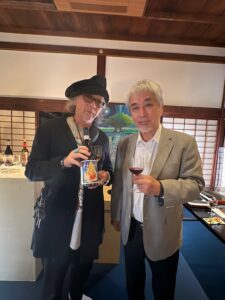
And we were keenly reminded that there is still a mountain of things we don’t know.
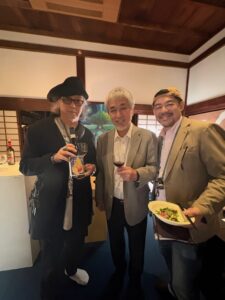
Today’s meeting featured remarks from so many experts—too many to count—offering such a wide variety of perspectives that it was hard to take it all in, but I found it to be a very stimulating meeting.
