

Blog&News
A Geopark is a place where people learn about Earth’s past through its geology and topography and engage in activities that help shape its future. UNESCO supports these Geoparks with the aim of preserving the formation history and geological heritage of the Izu Peninsula and utilizing them for education and the creation of a sustainable society.
On July 13, we visited the Izu UNESCO Club, a private, community-based organization that manages the Izu Peninsula Geopark.
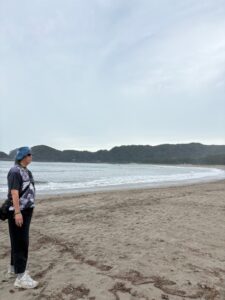
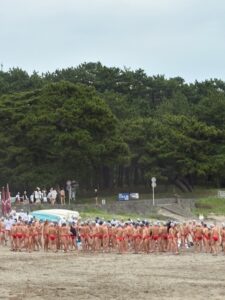
We stopped by Yumigahama, which is part of the Geopark. It’s a beautiful white-sand beach that curves in a 1.2-kilometer arc and has been selected as one of Japan’s Top 100 Beaches. High school boys in swim trunks began gathering on the sandy beach in droves. It seems a long-distance swimming competition is about to begin. The sight of young boys taking on long-distance swimming races—that continues to this day in coastal areas—seems courageous.
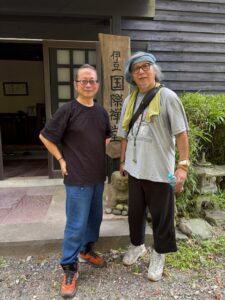
After that, we headed to the mountains in Minami-Izu Town, Kamo District, where the UNESCO office is located, and were shown around by Mr. Tsutsui, the person in charge.
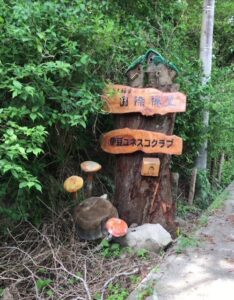
The view of the mountains from the “Ask the Earth” office is unobstructed and truly spectacular.
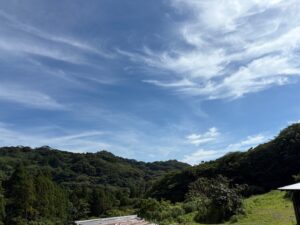
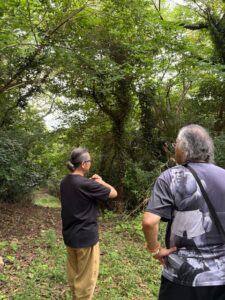
The mountain trail is covered in pristine forest, and there are open areas here and there—such as campsites and horseback riding grounds—which appear to be waiting to be put to use. The loud chirping of cicadas echoes throughout the forest.
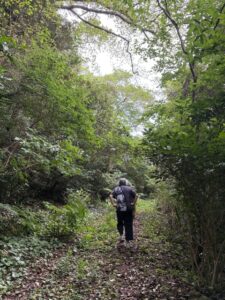
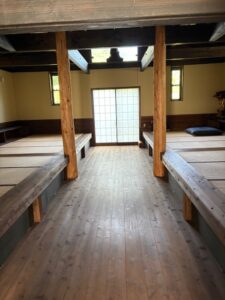
There is also a Zen meditation hall on the grounds.
Mr. Tsutsui led us to the hill behind the UNESCO grounds, saying there was one more place he wanted us to see. Looking out, we saw numerous massive wind turbines standing there. The eerie, low-frequency hum of the turbines—a sound distinct from the vibrations of humans and animals—echoed throughout the hills behind us.
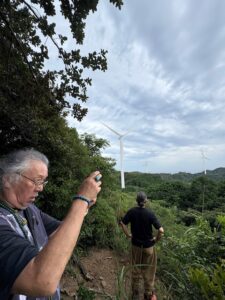
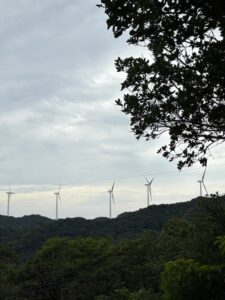
Since the mountainous area is privately owned and out of sight of nearby residents, it seems that wind turbines were installed there without the residents’ permission, and before anyone realized it. Just like solar panels, this is nothing more than a source of profit for a select few—a complete destruction of nature. This location, which borders a Geopark, is entirely unsuitable for such structures. There, we witnessed the stark reality of the cicadas’ chirping clashing with the strange noise of the turbines. What should we, as human beings, do moving forward into the future?
After that, we went to the home of Professor Emeritus Naoki Maruyama of Tokyo University of Agriculture and Technology, who serves as the president of the Japan Wolf Association, to meet with him.
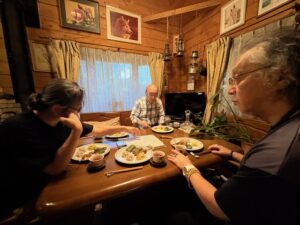
Professor Maruyama is working to restore the extinct Japanese wolf and is exploring ways to foster a harmonious relationship between forests, wolves, and people.
He shared many fascinating stories with us, including the reasons for the extinction of the Japanese wolf, the Ainu concept of hunting, legends written by Minakata Kumagusu, and the mystery of the “Tsuchigumo,” among other topics.
He explained just how large a wolf’s hand is—measuring 11 to 12 cm long and 9 cm wide— that it served as a kind of snowshoe on the snow.
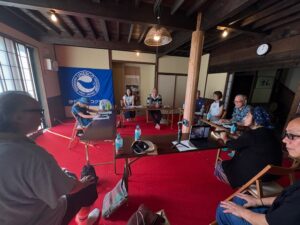
The next morning, on July 14, Mr. Keisuke Kobayashi, Executive Director of the Izu UNESCO Club, visited the Ask the Earth office, where Shiozawa gave a presentation on our activities to date.
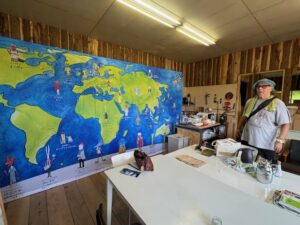
We were deeply impressed by Mr. Kobayashi’s background and his profound knowledge across a wide range of fields. Humans can be divided into two groups: agricultural peoples and nomadic peoples. Agricultural peoples evolve over a long period of time by repeating the same patterns, whereas nomadic peoples lack continuity between yesterday and today. Mr. Kobayashi stated that he is undoubtedly a nomad.
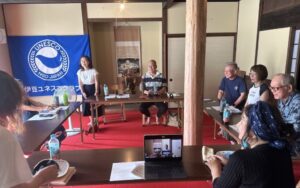
In addition, an event was held in the afternoon at the facility’s Zen meditation hall, where participants rang the Peace Bell and reflected on the meaning of peace.
Mr. Kobayashi gave an engaging lecture in which he read aloud a passage from the UNESCO charter, pausing after each sentence to carefully explain how the concept of peace differs from that in Japan.
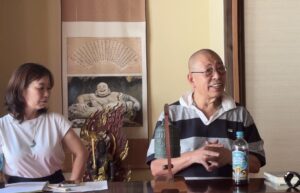
The term “peace” actually first appeared in Japan during the Meiji era. It began when the compiler of a Japanese-English dictionary translated the English word “Peace” as “heiwa,” imbuing it with the meaning of ending war. Until then, Japan had no word for “peace”; while concepts like “getting along” and “reconciliation” existed, they referred strictly to harmony within the family.
Mr. Kobayashi challenged the attendees to consider the essence of things and carefully explained useful insights drawn from his vast knowledge. He also stated that the key to eliminating conflict lies in not getting fixated on specific issues and in embracing diversity.
We often view things in a vague manner, but this was a valuable experience that reminded us anew of how important it is to consider the essence of things as we go through life.
We would like to once again express our gratitude to Representative Keichi Kobayashi.
