

Blog&News
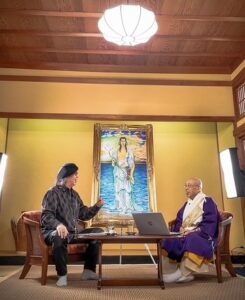
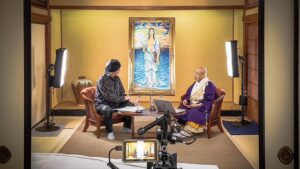
The long-awaited dialogue between Elder Morimoto and Shiozawa took place at Tōdai-ji Temple on December 4th.
We were also able to see the work Shiozawa dedicated to Tōdai-ji, the “Portrait of Prince Shōtoku at Age 19,” for the first time in three years.
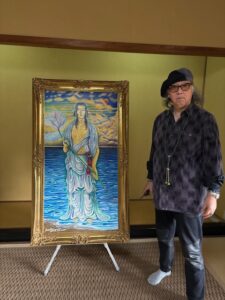
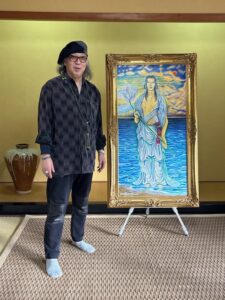
Today’s discussion topic is “The Teachings of the Flower Garland Sutra.”
While most people know about the Great Buddha, few realize that it materialised the teachings of the Avatamsaka Sutra. Shiozawa interviewed Elder Morimoto, intending to make a documentary film and broadcast it, hoping many people would come to know what the Kegon teachings are.
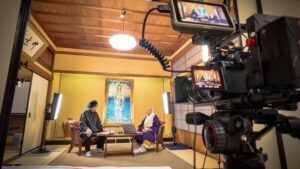
The main shoot began around 3:20 PM. Elder Morimoto spoke solemnly and without hesitation on the grand theme presented by Shiozawa.
The Great Buddha statue is called the Vishvanātha Buddha in Sanskrit. This means the one who shines brightly throughout the entire universe. It represents Shakyamuni at the moment of enlightenment.
A hundred years after Shakyamuni’s passing, foreign tribes (Pakistanis) invaded, and many people suffered under their oppression. How could this suffering be alleviated? A group of bodhisattvas, seeking to relive enlightenment, thoroughly investigated Shakyamuni’s awakening and compiled it into scriptures.
Through reliving enlightenment, they came to understand that when one gazes at all things to their absolute limit—to the point of infinite infinity—everything is interconnected. Even things that seem to oppose each other are, in truth, inseparable.
We shine brightly, illuminating one another, endlessly reflecting each other. Like a net of jewels, we radiate brilliantly, bound together by beautiful jewels. This is the landscape of the world of enlightenment and the essential essence of the Avatamsaka Sutra.
In today’s networked society, even as we connect, desire swirls within, bound by a dark sphere.
Moreover, in the Avatamsaka Sutra, by recognizing that nothing in this world exists eternally, it teaches humans—who are prone to falling into self-centeredness—that they cannot live alone.
Like a dazzling world adorned with flowers and jewels unfolding before us, it embodies the philosophy of human existence where we mutually support one another.
Before the Iraq War, Elder Morimoto, though a Japanese monk himself, went to Iraq to study Islam. There he experienced the difficulty of conveying the spirit of Buddhism. Buddhism is a philosophy of taking responsibility within oneself, and it offers no answer for what to do when an enemy actually attacks.
However, he concluded by saying, “While working to expand the web of images may be but a drop in the ocean, I believe it is important.”
The conversation went significantly over schedule, but Elder Morimoto grew more and more energetic as it progressed, and we heard some truly wonderful insights. This is just a small part of it.
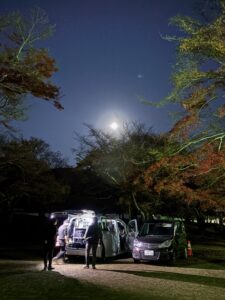
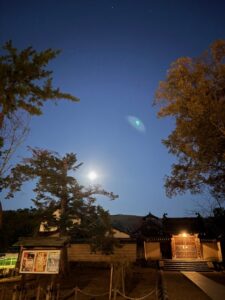
The surroundings had grown completely dark, yet the moon shone brilliantly.
As if teaching the radiant world of Kegon, the beautiful moonlight illuminated the now deserted grounds of Todaiji Temple.
